Tag: mindfulness

  • The Freeze Response

    The Freeze Response

    When the Body Goes Still: Understanding the Freeze Response

    There is a particular kind of stuckness that may not look like stuckness from the outside. A person is sitting across from someone — a partner, a colleague, a parent — and something inside goes quiet. Not calm-quiet. Another kind. Thoughts slow. Words that should be easy to find are suddenly far away. The body feels both heavy and somehow not quite one’s own. Later, the moment gets replayed, and the question arises: why didn’t I say the thing I meant to say, leave when I wanted to leave, feel what I thought I should have felt?

    If this is familiar, consider this: the body was not failing. It was protecting.


    What freeze actually is

    When the nervous system encounters a threat it cannot fight and cannot escape, it has one more card to play. It goes still. Heart rate slows. Breath gets shallow. Muscles hold. Sometimes there is a sense of watching oneself from a small distance, as if the moment were happening to someone else.

    This is called the freeze response, and it is one of the oldest survival strategies we have — older than language, older than reason, shared with most of the animal kingdom. When a mouse cannot outrun the cat, it goes limp. The cat, expecting a struggle, often loses interest. The mouse, if it survives, eventually shakes off the stillness and continues on.

    Humans do this too. They just usually don’t have the language for it.

    Why it shows up later, in places that seem safe

    Here is the part that can feel confusing and sometimes shameful. The freeze response does not always stay in the past. Once the nervous system learns that stillness is the safest option in a moment of overwhelm, it remembers. So a person might find themselves going quiet and far away in a difficult conversation that is, by any reasonable measure, not dangerous. They might lose their words in a meeting. They might notice the body going numb during intimacy, or during conflict, or while reading a text message.

    This is not a character flaw. It is not weakness. It is a nervous system doing exactly what it learned to do — trying to keep the person safe using the tool that once worked. The problem is not the response. The problem is that the response no longer fits the situation.

    What begins to help

    The instinct, when freezing begins, is often to push through. Force the words. Force the movement. Force the feeling. This rarely works, because the part of the self that has gone still is not being stubborn — it is being protective. It needs evidence that the present moment is different from the moment it is bracing against.

    A few things that tend to help, gently:

    Small movement before big movement. When a large action feels impossible, the smallest one is usually available. Moving one finger. Shifting the gaze. Pressing the feet into the floor and noticing the pressure. The nervous system reads these micro-movements as signals that the person is here, now, and not trapped.

    Orienting to the room. Look around. Let the eyes land on three specific things and describe them in some detail — the color of a book spine, the particular light on a wall, the pattern in the rug. This sounds almost too simple to matter, yet it does. Detailed looking pulls attention back into the present.

    Longer exhales. The out-breath is the part of breathing that calms the body. A slow count of five on the way out, whenever it can be managed, begins to tell the nervous system that the threat has passed.

    The part that froze is not the whole self. When freeze happens, it can feel as though the whole self has gone offline. But there is also the part that noticed the freezing, the part that sought out help, the part that is reading this post. Those parts are present too. The frozen part does not have to be the only voice in the room.

    What is worth knowing

    For anyone who has lived through something hard — and most of us have, in one form or another — and whose body has learned to go still in the face of overwhelm: there is nothing broken here. What is being carried is an old, intelligent survival response that has outlived its usefulness in certain moments. That is a workable problem. It is not a verdict on who a person is.

    The goal of this work is not to eliminate the freeze response. It is to give the nervous system newer information — that in this moment, in this room, with this person, in this present self, there is more room to move than there used to be.

    Slowly, with care, the stillness begins to soften. And somewhere in there, the words come back.


    For readers who notice these patterns in themselves, this is the kind of work a trauma-informed clinician can help with.

    Painting by Leilani Norman

  • Pathways to Navigating ADHD

    Pathways to Navigating ADHD

    LIVING WELL WITH ADHD

    Five Things That May Actually Help


    Many people with ADHD have tried a lot of strategies. Lists, timers, reminders, apps. Some help for a while. Many don’t stick. And when they fail, it’s easy to place the blame on the person who has ADHD.

    But neuropsychologist Dr. David Nowell offers a different explanation: most strategies fail not because of willpower, but because the foundation underneath them is shaky. Before any system can work, the brain needs the right conditions. He calls these conditions the “Big Five” — five keystone habits that support focus, mood, and energy at a biological level. Improve even one, and the others get easier too.


    1. Sleep Well

    The brain has a daily peak window — a stretch of hours when focus comes more naturally. Sleep debt shrinks that window dramatically. Simple steps make a real difference: a consistent bedtime, a cool, dark room, and no screens in the bedroom. Phone and TV content is designed to keep people awake, and it works. Sleeping until noon on weekends is often a sign that the brain is trying to catch up on a weekday deficit — a pattern worth paying attention to.

    2. Eat Protein at Every Meal

    Carbohydrates fuel the brain for minutes. Protein fuels it for hours. For a brain that already struggles with sustained attention, that difference adds up. No special diet is required — just making sure something with protein shows up at every meal and snack. Eggs, cheese, nuts, meat, legumes. Beyond that, paying attention to how different foods affect focus and mood an hour or two later can be revealing. Nowell encourages treating it like a science project, not a test to pass or fail.

    3. Move Every Day

    Exercise raises the same brain chemicals that ADHD medications target — and an hour at the gym isn’t necessary to feel the difference. Research suggests that ten minutes of movement intense enough to produce slight breathlessness is enough to improve focus. A brisk walk, a quick bodyweight routine, jumping jacks before a hard task. The goal is to find the minimum that works and make it a daily habit rather than an occasional event.

    4. Build a Support Team

    Nobody manages everything alone — and people with ADHD often struggle most with the exact things that pile up quietly and cause big problems: bills, appointments, planning, paperwork. Nowell encourages his clients to think about who already helps them, and where they might ask for a little more. A friend who’s good with money. A family member who helps with the kids. A grocery delivery service that removes a weekly planning headache. Even small additions to a support network can free up significant mental energy for what matters most.

    5. Use a Calendar — Intentionally

    A calendar isn’t just for appointments. For an ADHD brain, it’s a tool for deciding in advance where attention will go — rather than letting the most urgent or stimulating thing in the room take over. Nowell recommends keeping a running list of everything that needs to be done, then, once a week, moving the most important items to specific days and times. A brief scan each morning helps orient the day. And at day’s end, the most useful question isn’t “why did I fail?” but “what’s one small thing I could do differently tomorrow?” — asked with curiosity rather than judgment.


    These five practices work best together — each one supports the others. But changing everything at once isn’t necessary. Starting with whichever feels most manageable is enough. Progress in one area tends to carry into the rest.

    And when things slip — because they will — writing it off as failure misses the point. Getting curious is more useful. What happened? What got in the way? What’s one small adjustment worth trying? That’s not falling short. That’s learning how the brain works. And that’s exactly where lasting change begins.


    Based on Dr. David Nowell’s presentation at the PESI ADHD Summit, “ADHD, Neurodiversity, and Clinical Practice” (November 2022). Dr. Nowell is a neuropsychologist and adjunct instructor at Clark University who speaks internationally on executive functioning and the non-medication management of ADHD.

    Photo by Leilani Norman

  • You Don’t Have to Wait for the Anxiety to Go Away

    You Don’t Have to Wait for the Anxiety to Go Away

    If you’ve ever over-analyzed a text, held back something vulnerable, or convinced yourself your partner was pulling away — you’re not alone. Relationship anxiety is incredibly common. But here’s the thing:

    The goal isn’t to eliminate anxiety. It’s to stop letting it drive.

    Acceptance and Commitment Therapy (ACT) offers six practical skills to help you notice anxious thoughts, accept difficult feelings, and still act like the partner you want to be.


    The 6 Core Skills

    1. Mindfulness — Stay Present
    Anxiety lives in the past or future. When it spikes, pause, take 3 slow breaths, and notice what’s around you right now. Before speaking in a tense moment, try asking: “Why am I talking?” — it creates space to respond rather than react.

    2. Acceptance — Let Feelings Be There
    Fighting anxiety makes it stronger. Instead, name it: “I notice I feel nervous.” Remind yourself — feelings are temporary. They don’t define you or your relationship.

    3. Cognitive Defusion — Thoughts Aren’t Facts
    Add “I’m having the thought that…” before any worry. Instead of “my partner doesn’t care,” it becomes “I’m having the thought that my partner doesn’t care.” Suddenly there’s distance — and room to breathe.

    4. Self-as-Context — You Are More Than Your Anxiety
    Anxiety can feel like your entire identity — especially in relationships. But you are not your thoughts or feelings. You are the observer of them. No matter what anxiety whispers about you, there is a steady, stable “you” beneath it all — one that is not defined or threatened by anxious thoughts. That grounded self is always available to you.

    5. Values Clarification — Know What Matters
    Ask yourself: “What kind of partner do I want to be?” Honest? Compassionate? Attentive? Write down 2–3 values and let them guide your actions when anxiety gets loud. It can help to identify values by starting with “being”, as in “being a non-judgmental listener).

    6. Committed Action — Do It Anyway
    Share a feeling even if your voice shakes. Plan quality time despite your doubts. Express a need calmly. Confidence grows not by waiting for anxiety to leave — but by showing up anyway.


    Daily Practice

    Notice anxious thoughts → Accept the feeling → Remember your stable self → Identify a relationship value → Take one small action aligned with it.


    “Confidence grows not when anxiety disappears, but when you act in line with your values despite it.”

  • Time is Not Guaranteed

    Time is Not Guaranteed

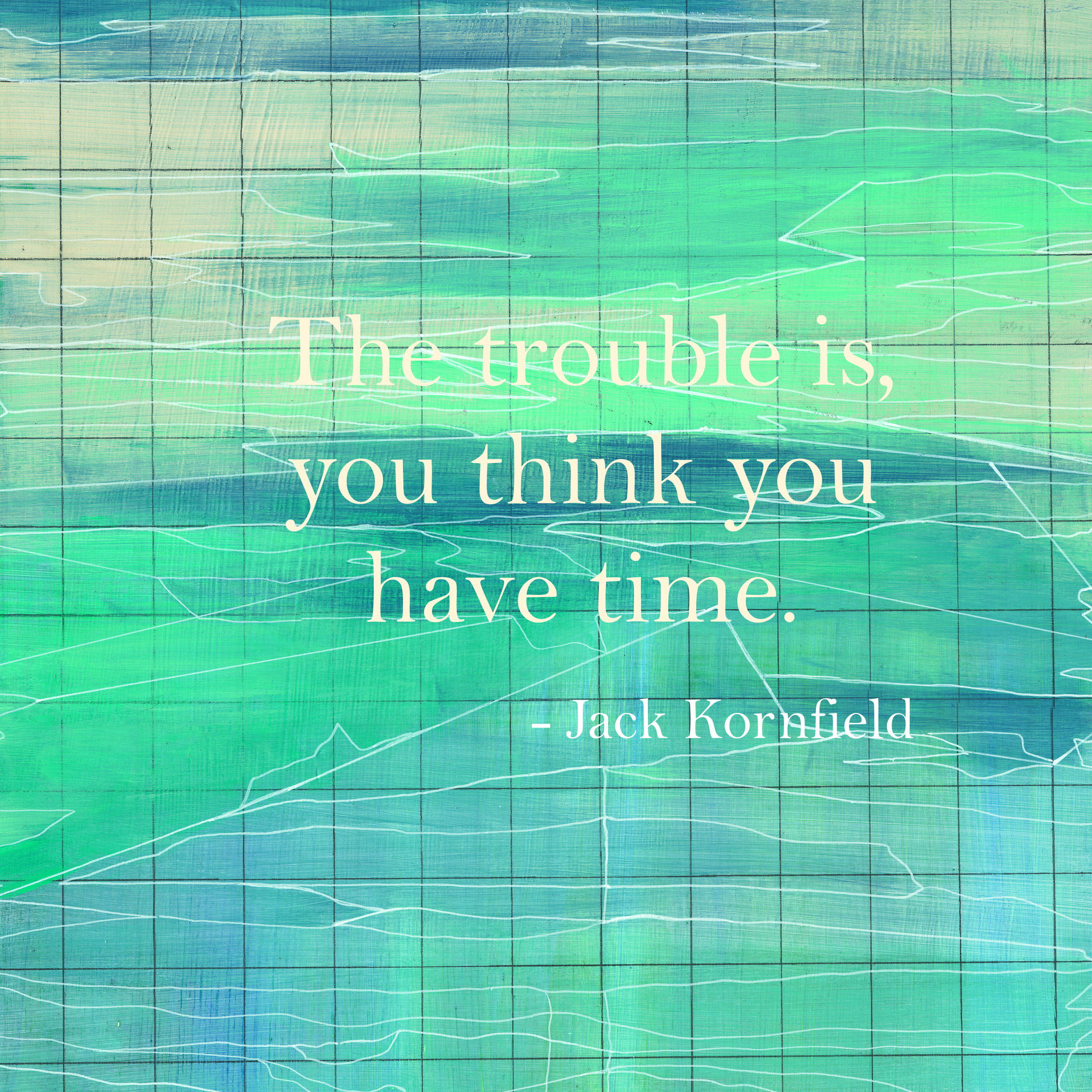
    This line points to a quiet but persistent illusion: that the important conversations, repairs, and risks can always wait. We assume there will be a better moment—when conflict eases, schedules open, or certainty arrives. Rooted in Buddhist reflections on impermanence, the quote is not meant to create panic but clarity. When we remember that time is not guaranteed, what truly matters tends to surface.

    In practice, the belief that “there’s still time” often protects us from discomfort. We delay apologies, postpone care, and defer honest expression. Yet avoidance compounds distance. Living with the awareness that time is finite is not about urgency; it is about presence. It asks us to choose deliberately—speak directly, repair sooner, and act in alignment with what matters while the opportunity is still here.

    “Cloud Farm” copyright Leilani Norman

  • Help for Caregiver Burnout

    Help for Caregiver Burnout

    ACT  for Caregivers

    Caring for someone you love can be meaningful—and also emotionally demanding. Acceptance and Commitment Therapy (ACT) is an evidence-based approach that helps caregivers respond to stress with greater flexibility, compassion, and clarity, while staying connected to what matters most.

    ACT focuses on building psychological flexibility: the ability to stay present, open, and engaged in life—even when things are difficult.


    The Six Core Skills of ACT

    1. Acceptance

    Making room for difficult thoughts and feelings

    Acceptance means allowing uncomfortable emotions (such as guilt, grief, anger, or exhaustion) to be present without fighting or judging them.

    Try this:
    When a difficult feeling shows up, pause and say silently:
    “This is hard—and I can allow it to be here for now.”
    Notice where the feeling shows up in your body and take 3 slow breaths.

    2. Cognitive Defusion

    Creating space from unhelpful thoughts

    Thoughts are not facts. Cognitive defusion helps you step back from distressing thoughts so they don’t run your life.

    Try this:
    When a painful thought appears, add the phrase:
    “I’m noticing my mind is telling me…”
    Repeat it slowly and observe how the thought feels less overwhelming.

    3. Being Present

    Coming back to the moment you’re in

    Being present means gently returning your attention to what’s happening right now, rather than getting pulled into worries or regrets.

    Try this:
    Name 3 things you can see, 2 things you can hear, and 1 thing you can feel in your body.
    No need to change anything—just notice.

    4. Self-as-Context

    You are more than your role or your struggles

    You are not just “the caregiver” or “the overwhelmed one.” You are the observer of your experiences—not defined by them.

    Try this:
    Silently complete this sentence:
    “I notice that I am having the experience of…”
    This reminds you that there is a part of you that can step back and observe.

    5. Values

    Clarifying what truly matters to you

    Values are qualities of living that guide how you want to show up—especially during hard times.

    Examples: compassion, presence, patience, connection, balance.

    Try this:
    Ask yourself:
    “In this situation, what kind of person do I want to be?”
    Write down one value that feels important right now.

    6. Committed Action

    Taking small steps aligned with your values

    Committed action means choosing doable actions that reflect your values—even when energy or motivation is low.

    Try this:
    Choose one small action you can take this week that aligns with a value you named (e.g., a 5-minute walk, asking for help, a moment of rest).

    A Gentle Reminder

    ACT doesn’t aim to remove stress or pain—it helps you change how you relate to them. You don’t need to feel better to live meaningfully. Small, values-based steps matter. You can care deeply—and still care for yourself.

  • Healing Reads

    Healing Reads

    Books

    ACT with Love

    by Russ Harris
    Learn to build more loving, accepting, and compassionate relationships with Acceptance and Commitment Therapy (ACT). ACT with Love will show you how to let go of conflict, open up, and live fully in the present, resolve painful conflicts and reconcile long-standing differences, and act on your values to build a rich and meaningful relationship. Highly recommended for couples, other relationships when deeper understanding and mutual appreciation are desired (maybe all of us?).

    The Science (and Art!) of Creating Lasting Sexual Connections

    by Emily Nagoski, PhD
    In “Come Together,” Nagoski tackles the common issues that hinder sexual connection in relationships. She refutes the myth that sexual desire declines over time and highlights the importance of enjoying sex rather than just its frequency. The book identifies obstacles like stress and body image and offers strategies for enhancing intimacy. Key focuses include understanding desire, improving partner communication, and recognizing emotional needs, all presented with a blend of scientific insight, humor, and compassion.

    Surviving and Thriving in Stepfamily Relationships

    by Patricia L. Papernow
    This book draws on current research, a wide variety of clinical modalities, and thirty years of clinical work with stepfamily members to describe the special challenges stepfamilies face. The book presents the concept of “stepfamily architecture” and the five challenges it creates, and delineates three different levels of strategies―psychoeducation, building interpersonal skills, and intrapsychic work―for meeting those challenges in dozens of different settings.

    Estrogen Matters: Why Taking Hormones in Menopause Can Improve Women’s Well-Being and Lengthen Their Lives — Without Raising the Risk of Breast Cancer

    by Avrum Bluming & Carol Tavist
    A compelling defense of hormone replacement therapy, exposing the faulty science behind its fall from prominence and empowering women to make informed decisions about their health. A sobering and revelatory read, Estrogen Matters sets the record straight on this beneficial treatment and provides an empowering path to wellness for women everywhere.

    I Don’t Want to Talk About It: Overcoming the Secret Legacy of Male Depression

    by Terrence Real
    The author writes that “depression is a silent epidemic in men; that men hide their condition from family, friends, and themselves to avoid the stigma of depression’s ‘un-manliness.’” Problems that we think of as typically male; difficulty with intimacy, workaholism, alcoholism, abusive behavior, and rage-are really attempts to escape depression. And these escape attempts only hurt the people men love and pass their condition on to their children.This ground breaking book is the “pathway out of darkness” that these men and their families seek. Real reveals how men can unearth their pain, heal themselves, restore relationships, and break the legacy of abuse. 

    Scream Free Parenting: 10th Anniversary Revised Edition: How to Raise Amazing Adults by Learning to Pause More and React Less

    by Hal Edward Runkel
    “You can have the structured, rewarding home life you’ve always craved, with respectful kids who are responsible for their own actions. All you have to do is learn to pause, so you can respond more and react less. It really is that simple. Once you learn to control your own emotions and behavior, your children will soon learn how to control theirs.”

    Fuel Your Brain, Not Your Anxiety: Stop the Cycle of Worry, Fatigue, and Sugar Cravings with Simple Protein-Rich Foods
    by Kristen Allott & Natasha Duarte
    Discover how high-protein, brain-fueling foods can help overcome anxiety, worry, and fatigue. It is common to struggle with anxiety, sugar cravings, weight gain, and fatigue. This practical, feel-better-now workbook offers ways to make healthier food choices and discover how protein and sugar affect emotions and energy.
    Convenient meal planning and tracking tools help monitor progress, and a wealth of easy tips and doable ways to improve diet, overcome fatigue, and restore vitality and mental clarity.


    No Time Like the Present: Finding Freedom, Love, and Joy Right Where You Are
    by Jack Kornfield
    The author offers wisdom through warmhearted, poignant, and
    often funny stories that provide keys for opening gateways to immediate shifts in perspective and clarity of vision, allowing us to grapple with difficult emotions and learn how to change course, take action, or—when we shouldn’t act—relax and trust. Each chapter presents a path to a different kind of freedom—freedom from fear, freedom to start over, to love, to be yourself, and to be happy—and guides you into an active process that engages your mind and heart, awakens your spirit, and brings real joy, over and over again.


    When Things Fall Apart: Heart Advice for Difficult Times
    by Pema Chödrön
    Drawn from traditional Buddhist wisdom, this book offers radical and compassionate advice for what to do when things fall apart
    by going against the grain of our usual habits and expectations.
    The self-described “example of ordinary neurosis,” the beloved American Buddhist nun offers practical and achievable practices.


    Self Help: This Is Your Chance to Change Your Life
    by Gabrielle Bernstein,Foreword byRichard C. Schwartz
    Bernstein demystifies the power of Internal Family Systems (IFS) Therapy, bringing its life-changing teachings into everyday life.
    Discover how extreme patterns like addiction, rage, pleasing, or constant self-judgment often develop as ways to suppress old feelings of inadequacy, shame, or fear. Once these patterns
    are brought into the light and cared for, healing happens swiftly.
    An enjoyable read and excellent companion book for those in IFS therapy.

    Podcasts

    Tara Brach
    Tara Brach, Ph.D is an internationally known meditation teacher and author of bestselling books Radical Acceptance, True Refuge
    and Radical Compassion. Tara shares a weekly guided meditation and talk that address the value of mindfulness meditation and self-compassion in relieving emotional suffering, serving spiritual awakening and bringing healing to our world.


    Being Well
    Conversations focus on the key insights from psychology, science, and contemplative practice that you need to build reliable inner strengths, overcome your challenges, and get the most out of life. A world-class group of experts explore the practical science of lasting well-being.

    You Are Not Broken
    Empowering women (and the partners who love them) to live their best lives. Combining the power of mind-work, body science, and relationships, Kelly Casperson, MD, “joyously breaks down the societal barriers that are keeping us from living our best intimate lives. Whether you are young or past menopause, single or in a long-term relationship, it is never too late or too early to realize YOU ARE NOT BROKEN.”